Source Self Regulating Electric Heating Cable for Pipes, Roofs, Tanks
Compare 18 self regulating electric heating cable options from verified Chinese manufacturers. Buyers can evaluate voltage, wattage, temperature ratings, and certifications to select the right solution for industrial heating and deicing applications.
Key considerations
Products List


Comprehensive Sourcing Guide
Strategic Sourcing Guide for Self-Regulating Electric Heating Cables
Understanding Technical Specifications and Performance Limits
When sourcing self-regulating electric heating cables, buyers must first distinguish between the specific model variations available in the market, as technical parameters vary significantly across different product lines. The core functionality relies on a polymer matrix that adjusts its electrical resistance based on ambient temperature, ensuring that heat output increases in colder conditions and decreases as temperatures rise. This mechanism prevents overheating and reduces energy consumption, a critical feature for long-term operational efficiency.
Based on observed product data, buyers should verify specific model identifiers such as SCW, SRS, SRM, and DWK. These identifiers often correlate with distinct performance profiles. For instance, certain configurations list a cold tail length of 2.5 meters, which is the non-heating section required for safe connection to power sources. The maximum exposure temperature for some units is rated at 205 degrees Celsius, while others specify a maximum energized temperature of 110 degrees Celsius and a maximum un-energized temperature of 150 degrees Celsius. These thermal limits are not universal; they depend on the specific model and application requirements.
Voltage requirements also vary by model. Some systems operate at 220V, while others support a broader range of 120V or 208-277V. In industrial contexts, voltage ranges may extend from 36V to 380V. The output wattage is another critical specification, often measured in Watts per meter (W/M) at a specific reference temperature, such as 10 degrees Celsius. Observed data indicates output capacities of 15, 30, 45, and 60 W/M. Buyers must ensure that the selected cable's wattage matches the heat loss calculations of the specific pipe or tank being protected.
Installation temperature constraints are equally vital. Several models indicate a minimum installation temperature of -40 degrees Celsius or -40 degrees Fahrenheit. Exceeding these limits during installation can compromise the integrity of the cable's self-regulating properties. Additionally, the conductor material is typically copper, often in a stranded configuration to provide flexibility and durability. The heating element itself may be composed of Ni-Cr wire, and the sheath material is frequently PVC, though other materials may be available for specialized applications.
Compliance and Certification Verification
Navigating the complex landscape of international certifications is essential for ensuring that heating cables meet safety and quality standards in the target market. The supply chain for these products often originates from regions such as Anhui, China, or Jinan City in Shandong Province. While the geographic origin provides context for manufacturing capabilities, it does not guarantee compliance. Buyers must independently verify that the specific lot of goods carries the necessary certifications for their region.
Observed certification data includes CE, ISO, RoHS, EAC, TUV, and CCC. The presence of CE marking is common, indicating conformity with health, safety, and environmental protection standards for products sold within the European Economic Area. ISO certifications, such as ISO9001, suggest that the manufacturer adheres to quality management principles. However, the specific standard listed, such as FSL/FSM/FSH, may refer to internal or industry-specific classifications rather than universally recognized safety standards.
Buyers should also look for RoHS compliance, which restricts the use of specific hazardous materials in electrical and electronic equipment. For markets in Russia and Eurasia, EAC certification is mandatory. In China, CCC (China Compulsory Certification) is a key requirement for domestic sales. The VDE standard, often associated with German safety testing, may also be present on products intended for European distribution. It is crucial to note that not every listed product satisfies all these certifications simultaneously. A single product listing might display a subset of these marks, and the buyer must confirm that the specific model ordered possesses the certifications required for their local regulatory environment.
Cost Drivers and Pricing Dynamics
The pricing structure for self-regulating electric heating cables is influenced by a combination of technical specifications, material costs, and order volume. The observed price range in the market spans from 0.2 to 30 USD, a wide variance that reflects differences in wattage, length, and construction quality. Lower-priced items often correspond to basic models with lower wattage outputs or shorter lengths, while premium pricing may reflect higher temperature ratings, specialized sheathing, or custom configurations.
Order Volume (MOQ) is a significant factor in determining the final unit cost. The minimum order quantity observed ranges from 1 to 1000 units. Buyers purchasing small quantities may face higher per-unit costs, whereas bulk orders can leverage economies of scale to reduce the price. The length of the cable per roll, often specified as 250m or 300m, also impacts the total cost. Longer rolls reduce the number of joints required during installation, which can lower labor costs, even if the initial material cost is higher.
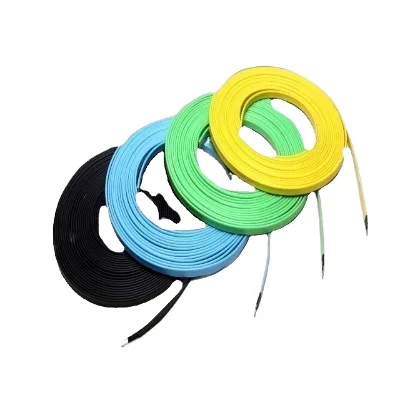
Customization is a major cost driver. Many suppliers offer customization for the model number, color, and packing standards. While the standard packing is often a carton or carton box, specialized requests may require wooden packing or wooden boxes, which can increase shipping and material costs. The standard dimensions for packaging, such as 40x40x20, may vary based on the customization request. Buyers should be aware that "Accept Customize" standards often imply a negotiation on price and lead time, as non-standard specifications require dedicated production runs.
Typical Applications and Installation Considerations
Self-regulating electric heating cables are primarily designed for heating and deicing applications. The observed data highlights their use in construction and industrial settings. The thermal efficiency of these systems is reported to be more than 95%, making them suitable for applications where energy conservation is a priority. The ability to adjust heat output based on temperature makes them ideal for protecting pipes from freezing in cold climates, where the minimum installation temperature can be as low as -40 degrees Celsius.
The shape of the heating element and the conductor type also dictate application suitability. Round wire and stranded conductors provide the flexibility needed for wrapping around pipes of various diameters. The shape of the heating element may be a plate or wire, depending on the specific model. For deicing applications, the maximum temperature rating of 100 degrees Celsius or 205 degrees Celsius must be matched to the material being heated to prevent damage.
Installation requires careful attention to the maximum installation temperature. If the ambient temperature during installation exceeds the specified limit, the cable may not function correctly. The cold tail length of 2.5 meters must be maintained to ensure a safe connection to the power supply, preventing the heating section from being energized at the connection point. The application type, whether heating or deicing, determines the required wattage and the specific model selection.
Supplier Evaluation and Origin Analysis
Evaluating suppliers requires a focus on their location, production standards, and after-sales support. The primary manufacturing locations identified are Anhui, China, and Jinan City, Shandong Province. While these regions are known for industrial manufacturing, buyers should not assume that all products from these locations meet the same quality standards. The origin of the product is a starting point for due diligence, not a guarantee of quality.
Suppliers often provide online technical support as part of their after-sales service. This capability is crucial for troubleshooting installation issues or addressing performance concerns. Buyers should verify the responsiveness and expertise of the technical support team before finalizing a purchase. The standard of the product, whether it is FSL/FSM/FSH or a customizable standard, should be clearly defined in the contract.
The material composition, such as Ni-Cr wire and PVC sheathing, should be verified against the supplier's documentation. The conductor type, typically stranded copper, ensures durability and flexibility. Buyers should request material safety data sheets (MSDS) to confirm the composition of the sheath and insulation materials. The certification status, including CE, ISO, and RoHS, should be validated for the specific batch of goods.
Quality Control and Long-Term Procurement
Quality control in the procurement of heating cables involves rigorous verification of specifications and performance claims. The resistance tolerance of +10/-5 % is a critical parameter that affects the uniformity of heat distribution. Buyers should ensure that the supplier provides test results or quality assurance documentation confirming that the resistance tolerance falls within this range. The maximum exposure temperature and maximum energized temperature must be strictly adhered to during operation to prevent premature failure.
Long-term procurement considerations include the availability of spare parts and the consistency of the product over time. The model numbers, such as SCW, SRS, SRM, and DWK, should remain consistent to ensure compatibility with existing systems. The packing standard, whether carton or wooden box, should be maintained to protect the cables during shipping. The ability to customize the product, including color and dimensions, should be a reliable option for future orders.
Buyers should also consider the lead time and the reliability of the supply chain. While specific lead times are not provided in the observed data, the MOQ range of 1 to 1000 suggests flexibility in order sizes. However, larger orders may require longer lead times. The thermal efficiency of more than 95% is a key performance metric that should be maintained over the lifespan of the product. Regular maintenance and inspection are recommended to ensure continued performance and safety.
Comparison of Key Product Attributes
To facilitate informed decision-making, the following table summarizes the key attributes observed across different product models. This comparison highlights the variability in specifications and helps buyers identify the most suitable options for their specific needs.
| Attribute | Model SCW | Model SRS | Model SRM | Model DWK | General Range |
|---|---|---|---|---|---|
| Certification | CE, ISO | EAC, TUV, ISO9001, RoHS, CE | RoHS, CCC, CE, ISO | CCC, CE, ISO, VDE | CE, ISO, RoHS, EAC, TUV, CCC |
| Max Temp (Exposure) | 205°C | 110°C (Energized) | 100°C | 100°C | 100°C - 205°C |
| Work Voltage | 220V | 120V / 208-277V | 36-380V | N/A | 120V - 380V |
| Output Wattage | 15-60 W/M | N/A | N/A | N/A | 15, 30, 45, 60 W/M |
| Installation Temp | -40°C | -40°C | -40°C | N/A | -40°C |
| Conductor Material | Copper | Copper | Copper | Copper | Copper (Stranded) |
| Sheath Material | PVC | PVC | PVC | PVC | PVC |
| Packing | Carton Box | Carton Box | Wooden Box | Wooden Box | Carton, Wooden |
| Origin | Anhui, China | China | Jinan, Shandong | N/A | China |
This table illustrates that while there is a commonality in materials and basic certifications, specific performance metrics like voltage and temperature ratings vary significantly. Buyers must cross-reference these attributes with their project requirements to select the correct model. The variability in packing and origin further underscores the need for detailed supplier verification. By carefully analyzing these factors, procurement teams can mitigate risks and ensure the successful deployment of self-regulating electric heating cables in their applications.
FAQs
What certifications are available for these heating cables?
Common certifications include CE, ISO, RoHS, EAC, TUV, and CCC depending on the model. Buyers must verify that the specific product batch carries the marks required for their local regulatory environment, as not every listing satisfies all standards simultaneously.
Which voltage options are supported by the different models?
Models support various voltages such as 220V, 120V, 208-277V, and ranges from 36V to 380V. The correct voltage must be selected to match the power supply and ensure safe operation of the specific self-regulating cable configuration.
How does the output wattage vary across the product range?
Output wattage is available in 15, 30, 45, and 60 W/M at 10 degrees Celsius. Buyers should calculate heat loss requirements to ensure the selected cable wattage matches the specific pipe or tank being protected effectively.
Can the product be customized for specific needs?
Yes, customization is available for model numbers, colors, and packing standards like wooden boxes. Non-standard specifications often require dedicated production runs, which may impact the final price and lead time for the order.
What are the maximum temperature limits for operation?
Maximum exposure temperatures can reach 205 degrees Celsius, while energized limits are often 110 degrees Celsius. These thermal limits vary by model and must be strictly adhered to during operation to prevent premature failure of the cable.
Where are these heating cables typically manufactured?
Products originate from regions such as Anhui, China, and Jinan City in Shandong Province. While these locations indicate manufacturing hubs, buyers should independently verify quality standards and certifications for the specific lot of goods ordered.